Designing a control room to inspire collaboration between operational teams.
The Problem
Funny enough, the Situation Room started at an internal company hackathon. Each participant was given free range to build whatever could be built on Elementum's current platform using our supply chain graph data. I joined a team with a mission to make a control tower experience, think NASA's control room* but for supply chain data. The primary (imagined) use-case was "a beautiful display of your supply chain, fit to hang in the CEO's office."
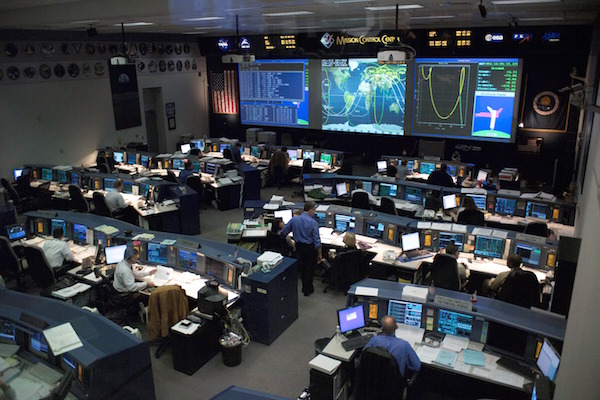
* NASA's control room: our inspiration.
We quickly sketched out our ideas, with only 6 hours to hack something together. We guessed at needing a large TV video wall made up of 9 TV screens. We figured there should be a way for the CEO to change the displays at will through a remote control of sorts.
Ideas + sketches in-hand, my team (composed of three designers + one marketer-turned-developer; we were the odd-duck out, where every other team was engineer-focused), wireframed low fidelity screens and prototyped the basic app flow in InVision.
My team was thrilled when our prototype nabbed us 1st prize at the hackathon. Little did we know, this was the beginning of a revolutionary product.
Users & Audience
We knew that the C-suite users loved to watch the news in their office, usually as a background noise, and they had dreams of their own mission control room. But it wasn't until our first Situation Room sold to a client that we found real use-cases.
"If you have six people looking at these screens, providing constant analysis, then magical things start happening in terms of developing really creative solutions" - Jim Rowan, Dyson COO
This was a huge opportunity to change the dynamics of how operation teams functioned.
Team & Stakeholders
There was no dedicated PM for this child-of-a-hackathon idea, so it ended up becoming a 20% project for whoever had bandwidth to work on it. Each app team (Transport, Exposure and Manufacture) were responsible for coming up with their own Situation Room "posters".
After a client expressed interest in buying and installing a Situation Room, all of the sudden this hackathon idea briefly became the center of Elementum's attention.
Constraints
At the hackathon, which was constrained to 6 hours, we didn't think about the actual implementation or technology requirements. We used inVision to put together a click through prototype of the remote control for the situation room and spoke to the idea of a Control Room set up with 9 screens in a 3x3 configuration. In reality, it took an insane amount of hacking to integrate with the TV screens array.
Design Process
There were two experiences that needed designs for the situation room: the viewers experience and the remote control experience.
As a viewer, we had questions like "how long would we want each poster to remain static on the screen before it rotated", or "if they wanted to go through multiple routes or product lines how would our designs accommodate this dynamic changing of screens?"
We designed an indicator that acted as a counter to visually indicate the time left before the change, and the actual transition needed to be smooth (no flickering) because 9 displays changing could be irritatingly distracting. For each app, we designed two posters that would reflect the overall status that each app was responsible for.
For Transport (my primary app), the two posters were "Bottlenecks" (which carousels through all the bottlenecks impacting that users routes) and "Route Performance" (which cycled though the overall health of the users' routes and carrier performance.)
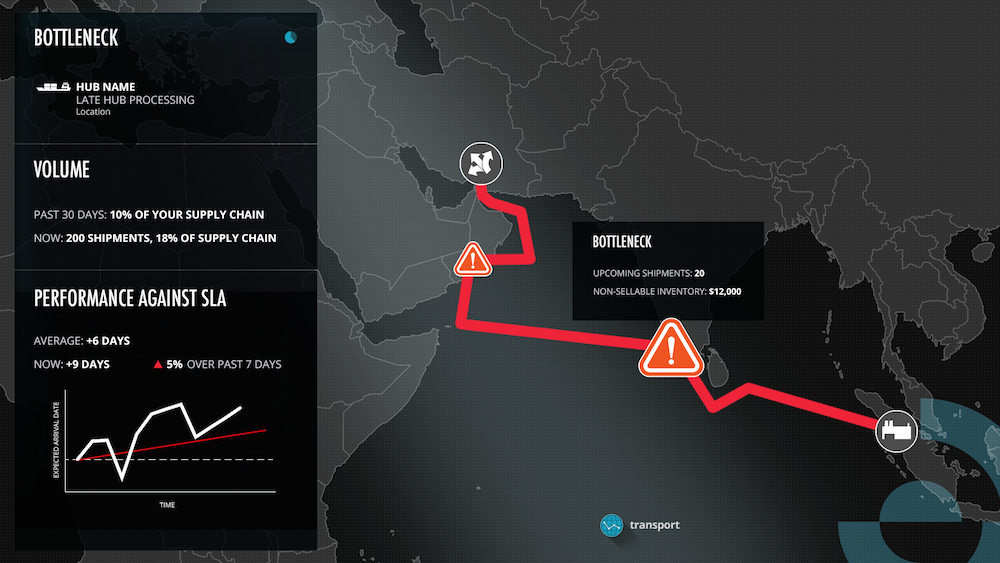
Early concept for Bottleneck poster.
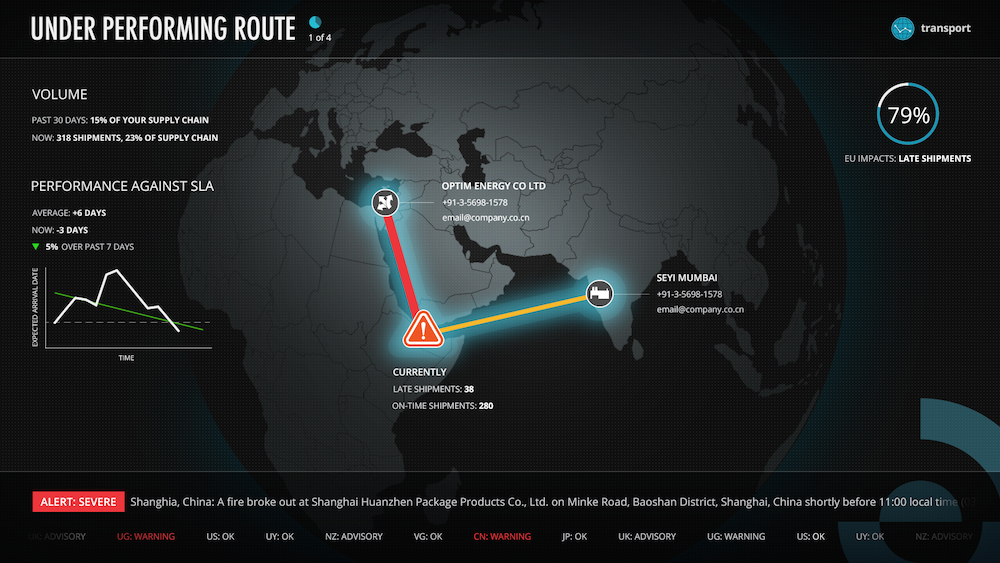
Underperforming routes poster for Situation Room.
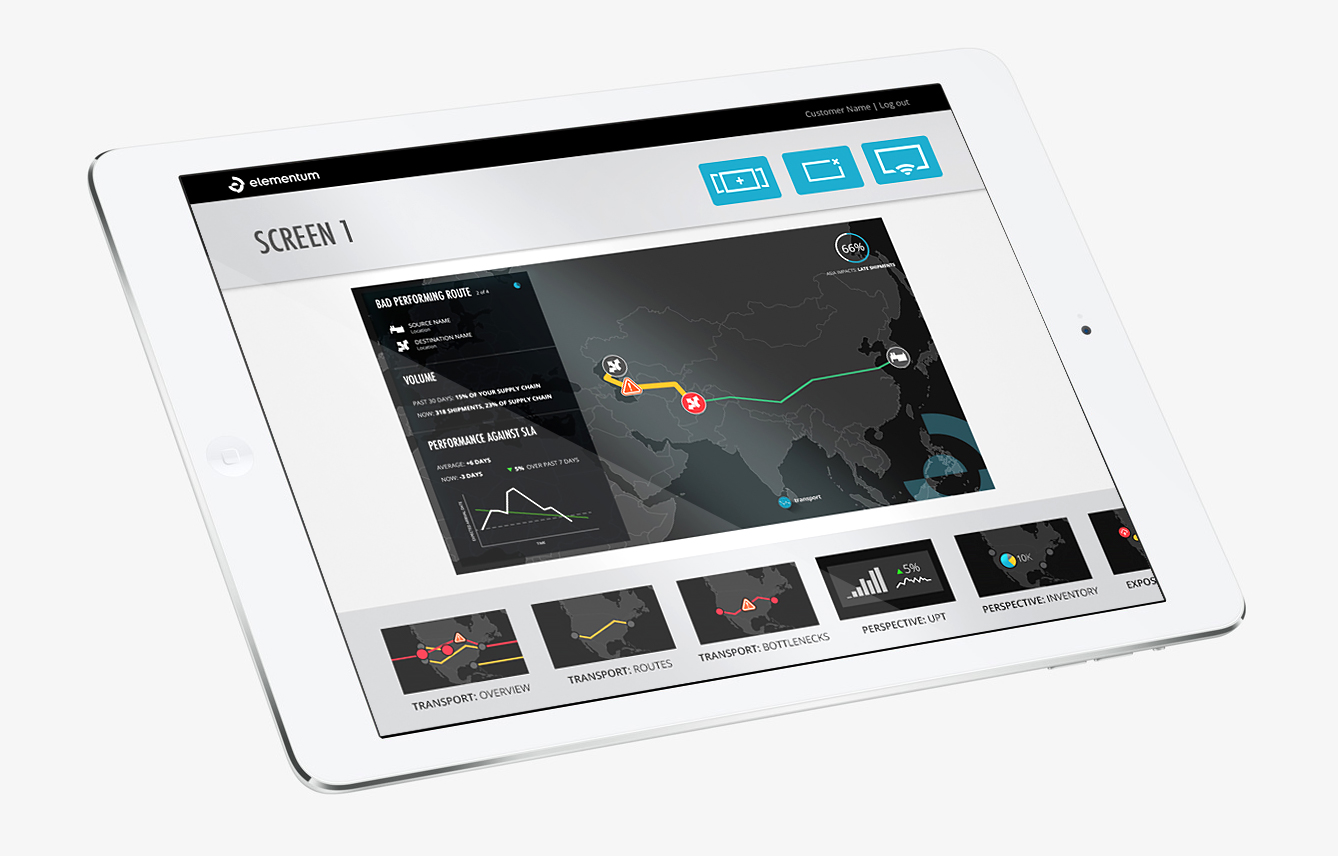
For the Remote Control experience, we designed a view that incorporated a thumbnail of the poster they were interacting with, including the position of the TV to be used for that poster. We also found that we needed a solid confirmation that the user updated a poster.
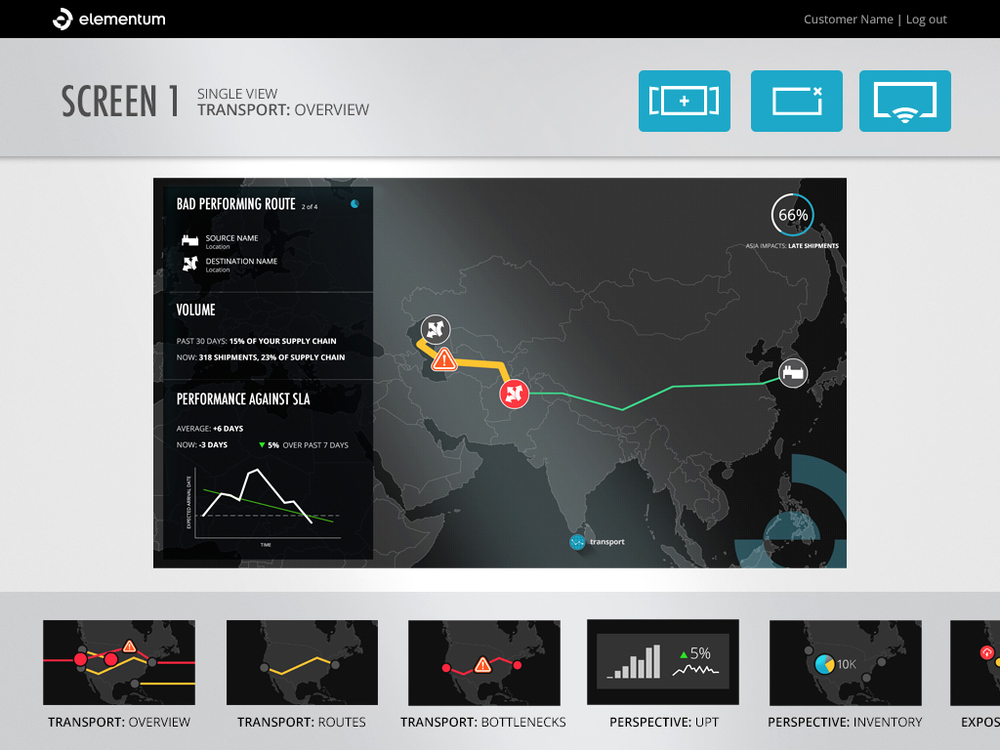
Remote control for Situation Room.
We did a lot of in-house testing with the remote to see how people felt about the general responsiveness and process of changing a TV screen. In the end, we found something that feels solid, intuitive, and responsive.
The Results
We now have two customers who have bought Situation Rooms and dozens of other companies that have expressed interest.
Retrospective
Ideas can come from anywhere.
It's amazing where ideas can come from.
A simple hackathon can create a viable product for a
company; that's amazing! I was impressed with the team
effort and hard work that went into bringing this
hackathon project to reality.
Start narrow, and work out towards more support.
Currently, there's a separate remote control iPad app, but
we've found it annoying that the user can't access their
situation room remote from the primary app they're in. Perhaps
in the future, we'll explore integrating the Situation Room
experience into each of our primary apps, It'll just become
another way for the user to explore their supply chain data.
Balancing 20% time is tough.
There's no easy way to make custom posters, but we've
received multiple requests to design custom Situation Room
screens. But because it's still a 20% project, we just
don't have the bandwidth to take these on.